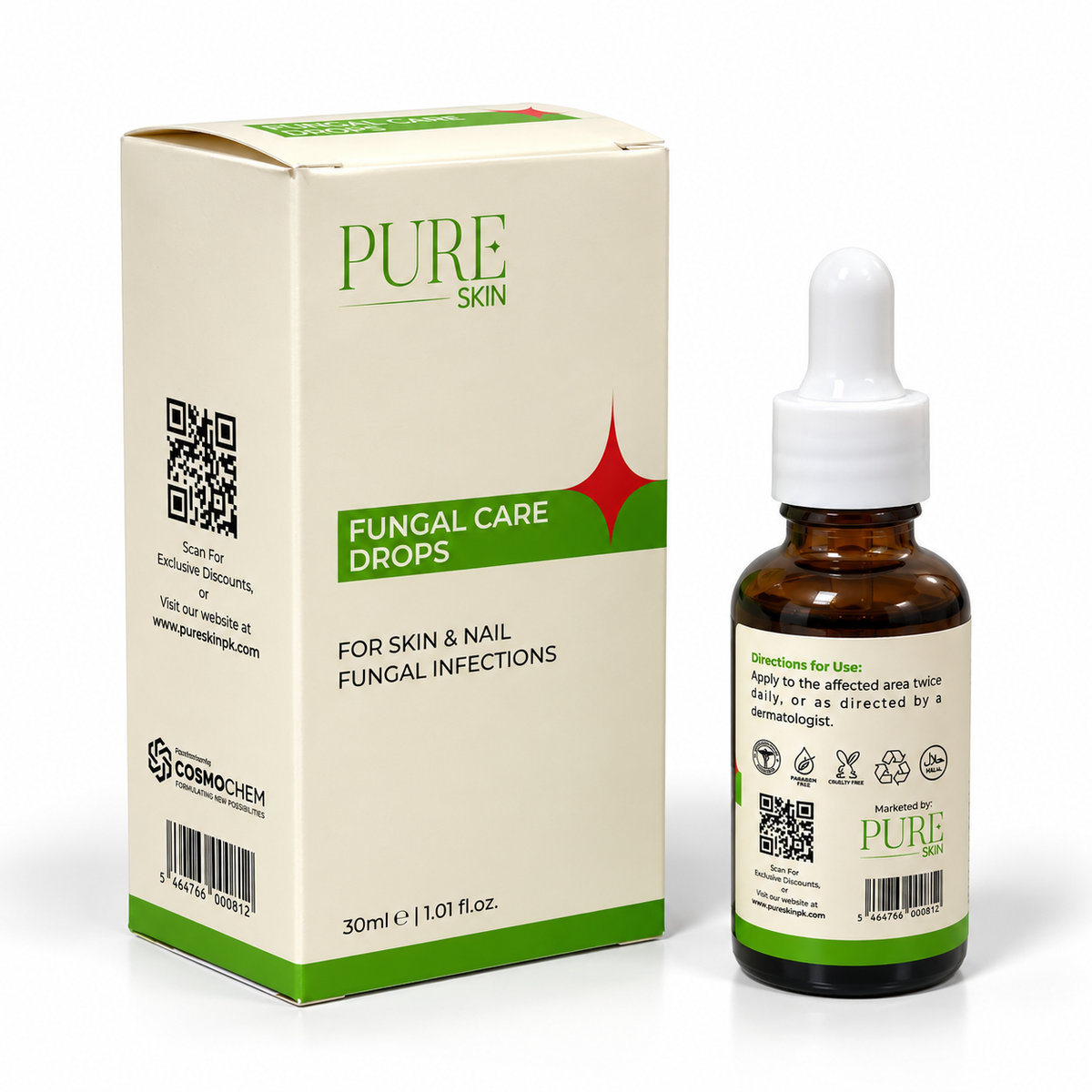
Two keratolytics, chosen for documented mechanisms.
Fungal-prone nails thicken. That buildup is what makes them hard to manage — and what blocks anything applied on top from reaching the nail plate. These drops pair urea with lactic acid, both documented keratolytics, to soften and break down that layer.
Soften
Urea disrupts hydrogen bonding in keratin, documented to soften and break down thickened nail and skin.1
Exfoliate
Lactic acid reduces corneocyte cohesion, allowing the roughened surface layer to shed.2
Balance
Alpha hydroxy acids lower surface pH, supporting the skin's natural acid mantle around the nail fold.2
Keratolytic & Humectant
Urea occurs naturally in the skin as part of its moisturising factor. Published reviews document a dose-dependent action: at lower concentrations it draws in and holds water, and at higher concentrations it becomes keratolytic, breaking hydrogen bonds within the keratin structure.1
This is why urea is described in the dermatological literature for softening thickened, hardened nail plate and the rough skin surrounding it — reducing the buildup that makes a fungal-prone nail difficult to file, trim and manage.1
Alpha Hydroxy Acid
Lactic acid is an alpha hydroxy acid documented for reducing the cohesion between corneocytes, which allows the roughened surface layer to shed rather than accumulate.2
Reviews also describe a dual effect: alongside exfoliation, lactic acid acts as a humectant and lowers surface pH, supporting the skin's natural acidic barrier around the nail fold.2
- Piquero-Casals J. et al. Urea in Dermatology: A Review of its Emollient, Moisturizing, Keratolytic, Skin Barrier Enhancing and Antimicrobial Properties. Dermatology and Therapy, 2021.
- Tang S.C., Yang J.H. Dual Effects of Alpha-Hydroxy Acids on the Skin. Molecules, 2018.
Research cited above reflects published scientific literature on the individual ingredients used in this formula. It describes ingredient-level mechanisms, not clinical testing of the finished product. This is a cosmetic care product and is not a treatment for fungal infection — if you have a diagnosed infection, follow your doctor's advice. Individual results may vary.
Three steps, twice a day.
Consistency matters more than quantity. The same short routine, morning and night.
Clean & Dry
Wash the nail and surrounding skin. Dry thoroughly — trapped moisture works against you.
Apply
2–3 drops onto the affected nail and the skin around it, twice daily.
Absorb
Let it dry fully before socks or shoes. Wash your hands afterwards.
Suitability
- Fungus developing or present inside the nail or on the skin around it
- Broken or bleeding skin
- Not for use on the face
Results timeline
- Week 2–3Visible differenceWith consistent twice-daily use, most people see a change by week two or three — the hardened nail softens, discolouration on the surface lifts away as the top layer exfoliates, and the skin around the nail fold looks clear and smooth.
Timeframes reflect typical ingredient-level research. Individual results may vary.