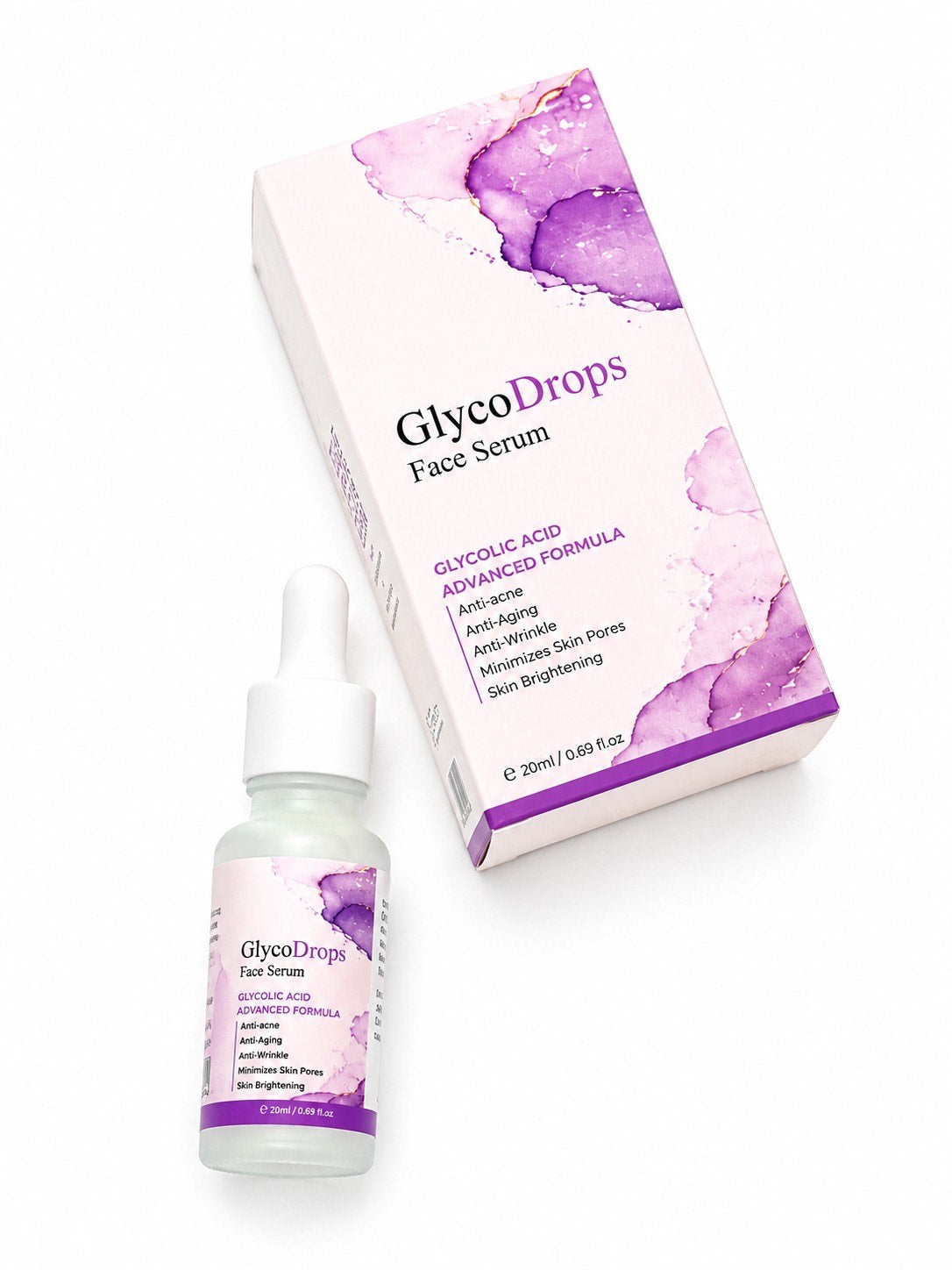
One acid family, three documented effects.
Glycolic acid is the most studied alpha hydroxy acid in dermatology. It works at the surface, where it loosens the bond between dead cells, and deeper, where research documents effects on collagen and pigment. Here is what the published literature describes.
Loosen
AHAs reduce the cohesion between cells in the outermost skin layer, allowing dull surface cells to shed more evenly.1
Renew
Glycolic acid is documented for accelerating collagen synthesis by fibroblasts, mediated by cytokines released from keratinocytes.2
Even
In-vitro work reports tyrosinase inhibition by glycolic and lactic acid — the enzyme that governs pigment production.2
 Skin surface renewal · illustration. (Illustrations are conceptual representations for educational purposes and do not depict actual laboratory imaging.)
Glycolic Acid
Glycolic acid is derived from sugar cane and is the smallest molecule in the alpha hydroxy acid family. That size is why it remains the most used AHA in cosmetic dermatology: a smaller molecule penetrates more readily, so it works both at the surface and below it.1,3
Published reviews describe its action as weakening the cohesion between dead cells at the skin's surface, allowing them to shed evenly rather than accumulating as a dull, uneven layer.1 Beyond exfoliation, reviews of AHAs in dermatology attribute improvements in skin texture, luminosity and collagen and elastin synthesis to this class of acids.3
 Mandelic acid & the pore · illustration. (Illustrations are conceptual representations for educational purposes and do not depict actual laboratory imaging.)
Mandelic Acid
Mandelic acid is the longest-chain derivative of glycolic acid, sourced from bitter almonds. Its phenyl side chain makes it more oil-soluble than the water-soluble AHAs, which is why the literature describes it as better suited to oily and acne-prone skin.2
It is also documented as gentler. Reviews describe mandelic acid as used for hyperpigmentation and melasma partly because its anti-inflammatory character makes it less irritating than other acids, and therefore more suitable for sensitive skin.3
- Cosmetic and dermatologic use of alpha hydroxy acids. PubMed ID 22916351. pubmed.ncbi.nlm.nih.gov
- Egli C., Min M., Afzal N., Sivamani R.K. et al. Hydroxy acids. Journal of Clinical and Aesthetic Dermatology. jcadonline.com
- Topical AHA in dermatology: formulations, mechanisms of action, efficacy, and future perspectives. Cosmetics, 2023; 10(5): 131. mdpi.com
Research cited above reflects published scientific literature on the individual active ingredients used in this formula. It describes ingredient-level mechanisms, not clinical testing of the finished product. Individual results may vary.
Where it fits in your routine.
Acids belong at night, on clean dry skin, and always with sunscreen the next morning.
Cleanse
Start with a clean, completely dry face. Damp skin increases penetration and irritation.
Wait
Give skin a few minutes to dry fully before applying.
This Serum
5–7 drops. Avoid the eye area and any broken skin.
Seal
Follow with moisturiser. AM: sunscreen is not optional with an AHA.
Skin suitability
- Congestion & breakouts
- Uneven texture & enlarged-looking pores
- Dullness & uneven tone
- Oily & combination skin
- Very sensitive or compromised skin (patch test first)
- Not for daytime use without SPF
Results timeline
- Week 1–2Smoother textureSkin feels softer and looks fresher as gentle resurfacing begins.
- Week 3–4Clearer, brighterCongestion eases and tone starts to look more even and radiant.
- Week 6–8Refined & renewedPores look minimized and fine lines appear softer with consistent use.
Timeframes reflect typical ingredient-level research. Individual results may vary.